
This supplement accompanies the four Work in progress papers: foundation edition 0.1, context and personal computing edition 0.3, and acceptance edition 0.4. It was revised on 16 October 2026. It separates supplied observations, arithmetic examples and proposed studies. The studies have not been run or preregistered. No raw conversations, native sessions or personal records are part of this release.
Measurement contract
Define an enrolled task before assignment: an immutable brief, starting source revision, authorized scope, task family, eligibility, pre-outcome difficulty band, budget, horizon and independent acceptance rubric. An attempt is a bounded execution episode. Retries and resumed sessions remain attached to the task. A response is a usage observation within an attempt. A session is not a task identity.
Retain the model and client versions, tool permissions, context selection rule, cache assignment and observed hits, compaction policy, attempt limits and intervention policy. Each evaluation must identify its rubric, artifact revision, environment, observer, time, result and evidence. Keep unknown, failed and not applicable distinct. Changing a relevant input requires checking whether the old observation still applies.
For coding work, acceptance combines held-out behavior checks, preserved regressions and scope review; test passing alone is a secondary endpoint. Writing requires a separate human rubric. External delivery requires the applicable deployment and user-path checks. These outcomes should not be pooled merely because all produce a file.
Normalize usage into disjoint ordinary input, cache reads, cache writes and output categories using the actual provider schema. Deduplicate by provider, account scope and response identifier. Record rate-card date, model, tier, region and context band. Reasoning already included in output is not charged again. Missing usage or cost remains unknown. Preparation is allocated over actual reuse, with preparation calls already present in response records counted once. Human active minutes are separate from money and elapsed waiting time.
Four-source reconstruction
Selected October 4 reconstruction summaries cover GG/1puni (including its subprojects as one organisation), nsnodes, Boating and OC. These are four organisational sources, not independent operator populations or comparable pooled outcomes. Observation endpoints and retention differ. The counts are summaries of selected private evidence, not a released dataset or an independent raw-source audit.
| Source | Selected identity and lifecycle diagnostic | Inference boundary |
|---|---|---|
| GG/1puni | 120 of 367 native blob identities appear in multiple task trees. 47,857 serialized appearances reduce to 7,239 event hashes; 46 repeated cumulative reports are removed before 4,909 Codex counter observations. | Inheritance is not execution. Four mismatches remain excluded; 159 cases use a labelled reset-like fallback, not a proven reset. The 1,136 latest message snapshots are a different unit. |
| nsnodes | 91 current read-only reviews and six digest tasks among 97 surviving refs; the six digest tasks have exact candidate landing links. | Six links out of 97 is not yield. Different task kinds require different evidence; absent exported trailers do not prove absent publication. |
| Boating | 1,080 matched done diary references resolve 465 commits; 994 references are ancestors of observed main. | The owner-inspected writer records repository HEAD at report time, including no-change closures. The other 86 references are not failed tasks. Done can include retirement; mutable pick counters are not execution totals. |
| OC | 895 serialized events yield 834 counter observations after removing 61 repeated cumulative reports. | This is a partial resource series without complete task or runtime/outcome joins. Code permits a done label before a later push failure; no such failure is established by that inspection. |
Identity normalization separates serialized appearances, event hashes, repeated cumulative reports and counter increments. A hash establishes content identity, not historical task ownership. Current task bindings were observed retrospectively; inherited artifacts cannot be charged once per containing tree. Recovery-era records and different native usage schemas stay separate. Unknown usage, billing, preparation, historical ownership and outcomes remain unknown. These diagnostics establish obstacles to measurement, not context benefit, failure prevalence or reliability improvement.
The earlier usage aggregate and frozen linkage slice below have distinct selection rules and denominators. Neither is joined to the four-source reconstruction into a pooled cost or outcome estimate. Public arithmetic can be checked, but the private source extraction cannot be independently reproduced from this edition alone.
Recovered operating evidence
The October 16 extension is separate from the October 4 cohorts above, the October 1 supplied usage aggregate and the October 2–3 frozen linkage slice below. It adds source-specific requirement, implementation and handling links, rather than a comparable sample of task outcomes. The Boating adapter preserves the selected source bytes and their record identities while translating source-specific fields into named observations; it does not convert a push report into independently observed publication. An independent review checked selected file hashes and uncompressed lengths, ordered invocation/result pairs against retained Git, requirement and before/after revision identities, duplicate-copy consistency and unchanged native-input identities. Requirement and defect summaries and extraction coverage remain source-owner selections; neither raw extraction nor historical runtime behavior was independently reproduced. Public reporting uses selected aggregates and method descriptions; private links, raw bundles and transcripts are not released.
| October 16 selection | Recovered evidence | Interpretation |
|---|---|---|
| Early Boating operating records | Six distinct native push reports corroborated by retained Git; two requirement-to-implementation chains | Weather change spans 18 paths; theme change spans six. Local Git and reported push success do not independently establish historical intended-remote containment, semantic acceptance or deployment. |
| Later weather brief | Source-owner summary reports no wind on real fetching after fixture-focused testing | Historical report, not a reproduced U-failure at an identified deployed revision/environment or a violation of the original fixture-only requirement. |
| Boating resource selection | 1,007 usage snapshots, 361 message identities, 67 loop starts | Distinct native units, without task-attempt or exclusive task-cost attribution. A shared session pointer is preserved across a done/quarantined duplicate. |
| Later nsnodes handling snapshot | 822 copies reduce to 118 receipts, each joined to an accepted decision/work; 105 overlap the October 4 cohort | Handling is complete while task-status keys are 109 done, seven blocked and two waiting; 67 replies are empty. No success rate or message-delivery count follows. |
| Unchanged nsnodes native inputs | 74 blobs and 3,200 serialized usage events; 12 additional task references describe procedures | Additional records do not enlarge the native usage sample. |
Observation and record dates have different meanings. An immutable requirement or later report is tied to its retained revision; a current mutable inventory describes the snapshot observed during recovery, not necessarily its state at an earlier cutoff. The October 4 table keeps its original selection and denominators. The October 16 recovery is a later analysis of selected retained evidence, not contemporaneous independent observation of historical operation. A gate invocation can skip fresh tests in the historical code and its retained result is tailed, so it supplies no fresh pass receipt. Unknown native completion, semantic acceptance, intended-remote containment, deployment and user outcomes remain unknown where their predicates require additional evidence.
These edges make useful work inspectable and clarify what a future cost or outcome evaluation must observe. They do not establish complete costs, context benefit, causal reliability gains or comparative organisational performance. Four source groups are not established independent populations; no pooled outcome rate is calculated.
Usage observation
The supplied observation covers 1 October 2026, 00:00–13:53:44 UTC, in 112 accessible coding-agent sessions. The collection account reports 634 unique response-usage records and agreement between response records and counter deltas, handling one counter reset using last-response counters. This edition checks the arithmetic; it does not independently reconstruct the underlying sessions or validate an invoice. Other tasks, providers and devices are outside coverage.
| Quantity | Supplied value |
|---|---|
| Input tokens | 18,920,180 |
| Cached input tokens | 15,394,688 |
| Noncached remainder | 3,525,492 |
| Cached share, rounded | 81.37% |
| Output tokens | 84,460 |
| Reasoning tokens, included in output | 4,490 |
| Maximum input in one response | 80,210 |
| Responses above 64k input | 7, all in one session |
The remainder is input minus cached input, not a known ordinary-input/cache-write split. The cached share is 100 × 15,394,688 / 18,920,180, rounded to two decimal places. Seven responses from one session do not constitute seven independent long-context tasks.
Task enrollment, attempts, acceptance, preparation allocation, tariffs, invoices, latency and active human effort are unavailable in the selected aggregate. Neither monetary savings nor accepted-task yield can be calculated from it. The aggregate is supplied evidence, not a released response-level dataset.
Linkage observation
This separate retrospective observation concerns admissions to a company documentation repository during the half-open interval [2 October 2026, 00:00 UTC, 3 October 2026, 13:14 UTC). A selection rule frozen before inspecting outcomes ordered admissions by time and then task identifier and took the first ten, regardless of status or data availability. There were 14 eligible admissions, ten selected tasks and 11 retained candidate revisions. Ten candidates had exact revision links to recorded landings by the cutoff.
Links were established by matching candidate revisions against the work-revision metadata of landing commits reachable from the observed main revision, with landing timestamps at or before the cutoff. The source observation occurred at 13:29:02 UTC on 3 October, after the cutoff. Versioned records permit this retrospective reconstruction; they do not make it contemporaneous runtime evidence.
10/11 is linkage coverage among retained candidates. It is not acceptance yield. Candidates are neither enrolled tasks nor a complete attempt ledger. Landing is not semantic author approval. An unlinked candidate is not evidence of a failed execution. Explicit execution keys were absent and execution and response records were incomplete or unavailable; missing records do not imply zero executions. Cost, billing, human effort, native completion, deployment and user outcomes remain unknown. The available task-description revision does not establish the original product input revision.
Completeness is limited to surviving versioned records, without an independent deletion or archive audit. The deterministic slice is not representative. No task, response, cost or outcome join connects this observation to the usage aggregate above. Raw records and identifiers are not released; the selected aggregate supports a bounded methods illustration, not independent reproduction of the original audit.
Replay
For fixed base B and d additional tokens per prior round, call k presents B + (k − 1)d tokens. Summing through call n gives nB + dn(n − 1)/2. The replay figure uses invented B = 100 and d = 20, with calls 1–10. Direct sums for n = 1, 2, 5 and 10 are 100, 220, 700 and 1,900 tokens. At n = 10, the cumulative total consists of 1,000 base tokens and 900 prior-round tokens.
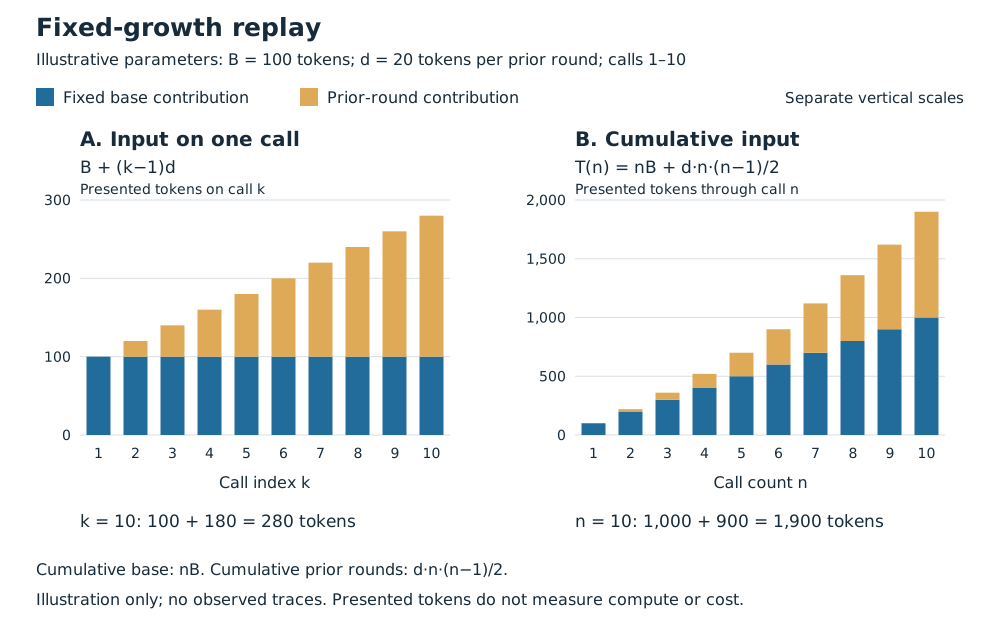
The two panels have different vertical scales. This is an algebraic illustration of presented input, not observed behavior, compute complexity, cost or a cache-savings estimate. Variable growth, truncation and compaction require response-level measurement.
Synthetic accounting
A small invented example makes the denominator explicit. Suppose two enrolled tasks together consume 12 currency units, including preparation, an unsuccessful attempt and a retry. If one task is accepted, cost per accepted task is 12 and yield is 1/2. Charging only the successful final call would answer a different question. If no task is accepted, report spend and zero yield; the ratio is undefined. If costs or outcomes are incomplete, report cost to date and coverage rather than a final ratio.
For fixed-horizon forecasts, score the mean squared difference between predicted probability and observed binary acceptance (the Brier score). Acceptance must satisfy both the time and resource budget. Predictions must precede the first outcome-bearing attempt. Score resolved outcomes with coverage and report conservative bounds: known acceptances divided by all enrolled tasks is the lower bound; adding unresolved tasks to the numerator gives the upper bound. Resolved-only scores may be biased when observation loss depends on the outcome. These are analysis definitions, not measured forecast performance.
Context study
The proposed comparison crosses three initial-context strategies with cold and warmed cache conditions. Every arm has the same essential brief, authority, repository, tools and retrievable source material. During the target stage, all arms accumulate new messages and tool results identically, using the same compaction rule.
| Arm | Initial context |
|---|---|
| Prepared | A task-relevant packet, proposed maximum 4k tokens, selected before outcomes by a preparer without the target solution. Charge preparation and record actual reuse. |
| Minimal with retrieval | Essential brief and authority only; search and file reading remain available and their costs are counted. |
| Growing history | Chronological records of authorized predecessor stages, proposed total initial-input cap 32k tokens. Prespecify history depths and truncation; exclude target-stage solutions. |
An instrumentation pilot proposes 24 independent task snapshots across at least three families, with three arms, two cache conditions and two repetitions: 288 trial slots: 12 per task block and 48 per context/cache condition, not 288 independent tasks. Tasks without predecessor records belong in a prepared/minimal-only extension. Validate instrumentation on six pilot tasks first. Proposed limits per trial are 20 minutes, 250k aggregate input tokens and 10k output tokens, allowing an initial attempt and at most two recovery attempts; stop when any limit is exhausted. Preparation has a separate measured budget. These numbers are feasibility choices, not a power calculation or evidence that the tasks fit the limits.
Use identical isolated starting states; randomize condition order within task and retain the seed. Fix model, reasoning setting, retry policy and compaction within blocks. Charge cache warming. Verify the manipulation from returned usage: a new session name or waiting period does not prove coldness. Cache-breaking can change the input or behavior, so retain an unmanipulated observational reference. Where isolation cannot be controlled, report observed cache strata and withdraw causal cache claims.
Report all-attempt cost per accepted task alongside acceptance yield, with preparation and failure costs visible. For a confirmatory replacement claim, the proposed upper 95% task-block-bootstrap interval for the prepared/minimal cost ratio must be below 1, and the lower interval for their yield difference must exceed −5 percentage points. The five-point yield margin has no demonstrated practical justification; justify it before confirmatory collection. Determine confirmatory sample size from pilot variance and a declared smallest useful effect (proposed cost reduction: 15%). Apply multiplicity control if secondary contrasts become confirmatory. Do not silently discard zero-denominator bootstrap samples. A conservative boundary policy is proposed, not implemented or registered. Freeze and validate the boundary procedure, draw count, seed, multiplicity family and allocation weights before confirmatory use. Each preparation record must be charged once, with allocation weights summing to one across actual reuse and repeated trials.
Resample whole task blocks, preserving arms and repetitions. Report cold and warm estimates separately before a mixture weighted by a stated deployment frequency. Show sensitivity to preparation reuse. Retain all enrolled failures and exclusions. Fully observed nonacceptance at the deadline is failure by that deadline; loss of observation before it is censoring. Withdrawals and permanent external blocks require separate treatment. Missing-cost arms provide lower bounds, not a savings claim. An underpowered null is inconclusive; tight equivalence bounds would be informative.
Acceptance study
Begin with a proposed consecutive 30-task measurement pilot, recording eligibility and exclusions before outcomes. Freeze model, tools, execution system, task rubric and required evidence coordinates. Observe native completion, independent acceptance, publication, deployment and user result separately. A deployment task may require the composite of acceptance, deployment and user success; a local writing task need not.
Proposed horizons are 15, 60 and 240 minutes, with exact resource caps fixed before collection. Record monotonic durations and UTC observation times. A result after a horizon does not change its earlier label. Autonomous and supported cohorts have different intervention policies and estimands; substantive human rescue cannot become autonomous success retrospectively.
The historical comparator source, sparse or unseen-stratum handling, primary horizon and multiplicity policy remain unresolved. The four-source description cannot supply a pooled baseline. Freeze these choices before collection. At enrollment, record an immutable probability forecast and a fixed task-stratified base-rate comparator for every declared horizon and budget. Bind them with a digest and independently recorded time before the first attempt. Landmark updates may use only evidence available then and must retain the original forecast. A file modification time alone is weak evidence of forecast priority.
| Behavior | Coding rule |
|---|---|
| Necessary warning | Missing authority or task-critical information prevents valid continuation. |
| Avoidable warning | The task contract already resolves the issue and an authorized, feasible next action exists. |
| Indeterminate warning | Available evidence cannot settle necessity. |
| Premature exit | Voluntary termination before acceptance while an authorized, feasible action remains within budget; exclude crashes, exhaustion and genuine authority blocks. |
| Recovery attempt | An observable action responds to an identified obstruction; code unchanged polling separately. |
| Intervention | A person's correction, clarification, configuration work, review or approval; record active minutes, not message gaps. |
Two independent coders should calibrate on held-out examples, freeze the codebook and double-code at least 20% of study observations. Preserve disagreements and report agreement and confusion matrices. Model-written reasons are declarations checked against actions, not the outcome oracle.
Compare fixed-horizon Brier scores against the frozen comparator using paired task-level uncertainty. Report calibration, counts, every horizon and observation coverage. Conservative yield bounds and resolved-only scores are a starting point; they do not solve informative censoring. Cancellation and permanent external blocks are competing outcomes, not innocuous dropouts. Forecast superiority requires a paired interval below zero for Brier-score difference on held-out tasks. Later cohort improvement alone does not establish learning: task mix, model changes, intervention and observation coverage must remain visible.
Historical replay
A historical extension compares strategies in reconstructed sandboxes using only the evidence and authority available at a specified decision boundary. Recover contemporaneous scope, permissions, cancellations and acceptance criteria; episodes lacking them are ineligible. Keep later outcomes sealed from both preparation and execution. Audit filenames, headings and tests for leakage as well as document dates.
Give arms equal access to pre-cutoff material and charge reconstruction, preparation and retrieval. Use fresh isolated states and scripted external dependencies where required, labeling those substitutions. Current models may contain later information from training; repository isolation cannot remove that contamination. Exclude tasks whose answer depends on such information or report the limitation explicitly.
Freeze interruption points and five probes: current objective, authority, accepted work, remaining obligation and justified next action. If an authentic historical interruption cannot be established, label the intervention synthetic. A forecast must precede its replay; known historical outcomes cannot be retrospectively forecast. The result estimates a sandbox contrast, not what the original agent would have done or an effect on real users. No historical trial is reported here.
Synthetic walkthrough
The personal-computing paper draws on a deterministic local fixture first checked on 2 October 2026. Its inputs are two invented text files, a structured declaration and selected context. A fixed proposer uses explicit search paths and shell composition; an independent literal oracle checks the candidate. The fixture uses a disposable Git repository and a fresh subprocess for reconstruction. It makes no model or network calls and installs no service.
| Step | Observation in the fixture |
|---|---|
| Select alpha and beta | The exact two-line candidate passes. |
| Change intent to alpha-only before acceptance | The old candidate is rejected as stale. |
| Start a fresh proposer from disk | The current alpha-only candidate passes. |
| Substitute wrong text with a consistent digest | The independent content check rejects it. |
| Change context after proposing | The candidate is rejected as stale. |
| Restore context and repeat the accepted proposal | The candidate is unchanged and creates no working-tree change. |
The accepted content is the line “FACT: alpha selected”, followed by a newline. These checks establish deterministic selection, revision checking and reconstruction only. The declaration and expected answer were supplied by the fixture author. A fresh subprocess is not a crash-recovery test. The fixture has a single trusted writer, no OS-enforced sandbox, no concurrent acceptance boundary, no scheduling, GUI, network effects or semantic interpretation. Missing-file and parse errors terminate it; adaptive repair is not implemented. This public supplement describes the selected fixture; it does not distribute its underlying research package.
A model-backed extension would retain the independent outcome check and restrict execution to selected reads, search, candidate writes and submission. Enforce path and operation scope outside the model and serialize steering with acceptance. Test novel declarations, contradictory sources and corrections carried into unseen variants. Keep model weights fixed; the proposed adaptation changes external context and procedures. Remote effects need separate idempotency and recovery designs: reverting a file does not unsend a message.
Personal-computing study
Compare a competently configured conventional workflow, stateless model assistance and a situated environment with durable context and retained procedure revisions. All conditions receive equivalent tools, input access and outcome rules. The conventional arm may use scripts, scheduling and normal documentation. Match model and wrappers between model arms; charge the effort of resupplying facts. Ablate context retention and procedure revision separately within the situated condition.
Use the paper's research brief, offline collection and interrupted draft families, with matched variants covering unchanged repetition, changed intent, missing input, interruption and platform transfer. Counterbalance condition order. Separate experienced Unix users from participants unfamiliar with scripting. A one-person feasibility case cannot establish ordinary-user benefit.
The primary comparison is user orchestration minutes per assigned task across setup, repeated work, change and recovery, accompanied by independently accepted yield. Report success, intervention, recovery, portability, total cost and change burden separately. Record active user and maintainer time, including corrections, review, help, regressions and repairs over a fixed follow-up period. Inject interruptions before acceptance and after output; count stale actions and duplicate effects. Test an outcome-equivalent subset on Linux and a named second platform, retaining adapter effort and unsupported behavior.
Use a prewritten outcome rubric and evaluators blind to condition where feasible. Analyze paired differences with uncertainty clustered by participant. Choose confirmatory sample size, minimum useful effort reduction and a yield noninferiority margin after a variance pilot but before new confirmatory data. No numeric margin is justified yet. A conventional or stateless workflow with equal yield and lower total burden would narrow the hypothesis. Report it accordingly.